
How to Stop Light Pollution on Campuses and Municipal Facilities
 LiteSource
|
March 11, 2026
|
Agency News
LiteSource
|
March 11, 2026
|
Agency News
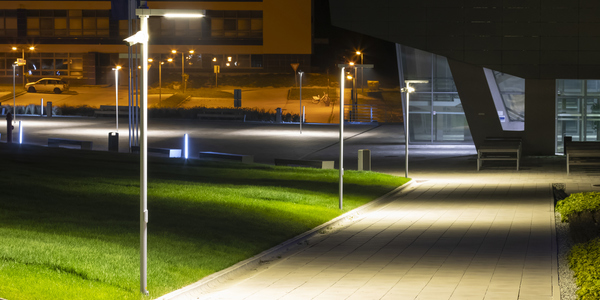
How to Stop Light Pollution on Campuses and Municipal Facilities
Balancing Safety, Visibility, and Night-Sky Protection
Campus and municipal lighting has to do three things at once: support safety, maintain visibility, and reduce nuisance light. The strongest dark-sky plans are not about using less light everywhere—they’re about using the right distribution, controlling high-angle light, choosing warmer color temperatures, and dimming by schedule. DarkSky, the international lighting organization dedicated to preserving our night skies, provides guidance consistently centers on shielding, appropriate light levels, and color.
Start with Layout, Not Fixture Wattage
Start with layout, not fixture wattage. Campuses and municipalities usually mix paths, parking, roadways, entries, and public gathering areas, so one optic pattern rarely fits every zone. A practical approach is to divide the site into activity areas (primary circulation, secondary paths, parking, decorative/perimeter), then assign the right distribution type (Type II, III, IV, or V) based on geometry and setbacks before sizing output. This reduces over-lighting and avoids adding poles just to “fix” coverage gaps.
Use BUG Ratings as a Quick Filter
Next, use BUG ratings as a quick compliance and comfort filter. BUG (Backlight, Uplight, Glare) helps you compare how much light is spilling behind the pole, above the fixture, or into high-angle views. It’s especially useful at residential edges and along campus perimeters, where glare and trespass complaints usually show up first. The IES/IDA Model Lighting Ordinance framework specifically incorporates BUG to better control unwanted outdoor light.
Control Tilt and High-Angle Light
Tilt control is just as important as fixture choice. Even a good optic can create glare and trespass if it’s tilted unnecessarily. Defaulting to zero-tilt mounting, then using shields and proper pole spacing, usually produces better results than trying to “throw” light farther with angle. DarkSky’s luminaire guidance also reinforces shielding and limits on high-angle output as core principles for responsible outdoor lighting.
Choose Warmer Color Temperatures After Dark
Color temperature matters after dark. DarkSky’s luminaire recommendations sets a maximum of 3000K for approved luminaires, and that’s a strong practical default for most campus and municipal sites. Warmer light reduces visual harshness and supports dark-sky goals, especially along residential edges, pedestrian routes, and lower-traffic areas.
Build Dimming Schedules Around Actual Occupancy
Finally, build dimming schedules around actual occupancy. DarkSky’s direction requires dimmability to 10% or less for approved luminaires, which supports practical nighttime scheduling. Keep primary paths and key entries at stable levels, then dim parking and secondary zones later in the evening rather than leaving everything at full output all night. This improves comfort, reduces skyglow, and cuts energy use without sacrificing wayfinding.
At LiteSource, we make lighting simple—helping teams turn dark-sky goals into clear, compliant site lighting decisions that balance visibility, comfort, and night-sky protection.