

Security Bollards: Life-Saving Architectural Infrastructure
Featured Products | June 03, 2026 | The Lighting Exchange
Bullard Bollards · Public Safety
Security Bollards: Life-Saving Architectural Infrastructure
Good design creates beautiful spaces. It should also protect the people inside them.
A car wash. A playground across the street. A driver who suffered a medical emergency behind the wheel — his foot pressed to the accelerator, no control, no warning.
The car crossed the street and entered the playground.
There were no bollards. There was nothing between the vehicle and the children playing on the other side. Two children lost their lives.
This happened. It was not a security breach, not an act of violence, not something that could have been predicted or prevented by surveillance or fencing. It was a vehicle, a medical event, and an unprotected space. The kind of scenario that doesn't make the news for long but leaves the people who work in public safety design quietly rethinking every open edge they've ever specified.
The Gap Between Safe-Looking and Safety
Public spaces are designed with enormous care — materials, planting, lighting, seating, accessibility. The experience of a well-designed playground, park, or pedestrian plaza feels considered and intentional. It looks safe. It feels safe.
But vehicle intrusion — whether from medical emergencies, mechanical failure, or distracted driving — doesn't respond to landscape design. A beautifully planted edge offers no resistance. A flush curb offers no resistance. Without a physical barrier rated to stop a moving vehicle, the perimeter of a public space is, structurally speaking, open.
That's not an argument for turning every public space into a fortress. It's an argument for understanding what protection actually requires.
What Security Bollards Do — And What They've Become
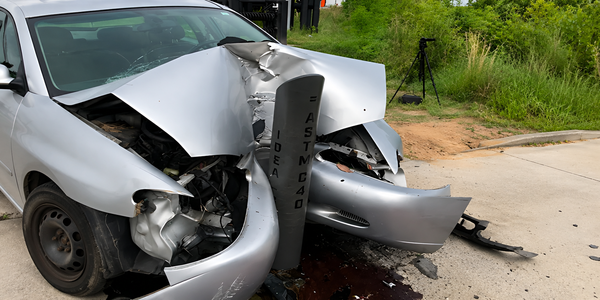
A crash-rated security bollard is engineered to absorb and redirect the kinetic energy of a moving vehicle. Depending on the rating — ASTM or K-rated — the system is tested against specific vehicle weights and impact speeds. The bollard stops the vehicle. The foundation transfers the force into the ground. The protected zone behind it remains protected.
That's the structural function. What's changed in recent years is everything around it.
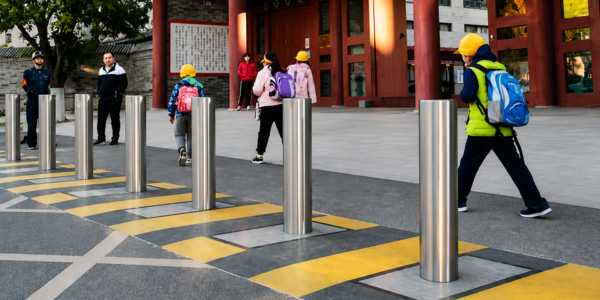
Modern security bollards are architectural elements. They come in a range of materials, finishes, and forms — brushed stainless steel, powder-coated steel, cast iron, concrete-filled with decorative caps, and recently Nano-Coated. Illuminated versions integrate lighting directly into the bollard, serving wayfinding and ambient lighting functions alongside their protective role. Decorative versions are indistinguishable, at a glance, the protection being invisible.
Where This Applies
The playground scenario is extreme, but the underlying exposure is not. Vehicle intrusion into pedestrian spaces happens regularly — at restaurants with sidewalk seating, at school drop-off zones, at park entrances, at transit plazas, at storefronts. Most incidents don't involve fatalities. Many don't make the news at all.
The spaces most in need of consideration:
- Playgrounds and parks — high concentration of children, often adjacent to roads or parking areas, rarely protected
- Schools — drop-off and pick-up zones, pedestrian paths between buildings, outdoor gathering spaces
- Restaurants and retail — sidewalk seating and pedestrian-facing storefronts are among the most common sites for vehicle intrusion incidents
- Plazas and civic spaces — open, inviting edges that are structurally unprotected by design
- Pedestrian zones — streets converted to foot traffic that retain vehicle access points at the perimeter
The Design Responsibility
CPTED (Crime Prevention Through Environmental Design) principles have long held that good design and safe design are not in conflict. A space that feels open, welcoming, and well-considered can also be physically protected. The two goals don't compete. They reinforce each other when the specification accounts for both.
The playground didn't look unprotected. It just was.
Security bollards won't prevent every tragedy. But they close the gap between a space that looks safe and one that actually is — and in the right conditions, that gap is the difference between a close call and something no community should have to go through.
Other News Content by:
Bullard Bollards
Die-Cast vs. Extruded Aluminum: Choosing the Right Alloy for Outdoor Fixtures
Design Tips & Techniques | September 24, 2026 | The Lighting ExchangeSymmetrical vs. Asymmetrical Lighting — Choosing the Right Distribution for Your Project
Design Tips & Techniques | August 18, 2026 | The Lighting ExchangeSolar Security Bollards — A Smarter Way to Protect a Site
Featured Products | July 10, 2026 | The Lighting Exchange