

Symmetrical vs. Asymmetrical Lighting — Choosing the Right Distribution for Your Project
Featured Products | July 10, 2026 | The Lighting Exchange
When a lighting fixture is selected, most of the conversation centers on output, color temperature, fixture style, and energy performance. The distribution pattern — how the light actually spreads from the source — often receives far less attention than it deserves.
Symmetrical and asymmetrical light distribution are fundamentally different tools. Understanding what each does, and where each belongs, is the difference between a lighting design that performs as intended and one that looks right on paper but falls short in the space.
What symmetrical distribution means
A symmetrical fixture distributes light evenly in all directions from the source — the beam pattern is the same on every axis. Positioned above a space, it produces a circular or uniform cone of light that spreads equally outward in every direction.
This makes symmetrical distribution well suited to applications where the goal is general, even illumination across an open area — a plaza, a courtyard, a park, a residential living room. The light fills the space without prioritizing any particular direction. It's predictable, easy to model, and straightforward to specify.
The limitation is precisely that evenness. When a surface, path, or zone needs more light in one direction than another, symmetrical distribution either overwaters one side or underserves the other.
What asymmetrical distribution means
An asymmetrical fixture throws light directionally — more output in one direction than others. The beam pattern is intentionally offset from the center axis of the fixture, designed to reach further in a specific direction while limiting spill in others.
This makes asymmetrical distribution the correct choice for any application where light needs to be directed rather than spread. A roadway luminaire mounted at the edge of a carriageway needs to reach across the full lane width without flooding the footpath behind it. A facade-mounted fixture needs to wash a wall surface without bouncing back toward pedestrians. A bollard path light needs to illuminate the ground plane ahead without creating glare at eye level.
In each of these cases, asymmetrical distribution delivers where the light is needed and withholds it where it isn't — a precision that symmetrical distribution structurally cannot provide.
Exterior applications: where the distinction matters most
In outdoor lighting, the choice between symmetrical and asymmetrical distribution has direct consequences for safety, energy efficiency, and visual comfort.
- Roads and pathways — asymmetrical distribution is almost always the correct specification. The goal is to illuminate the travel surface evenly, maintain consistent footcandle levels across the lane or path width, and avoid light trespass onto adjacent properties or upward into the sky. A symmetrical fixture mounted on a roadside pole will always waste a portion of its output behind the pole, into landscaping, or upward — none of which serves the road.
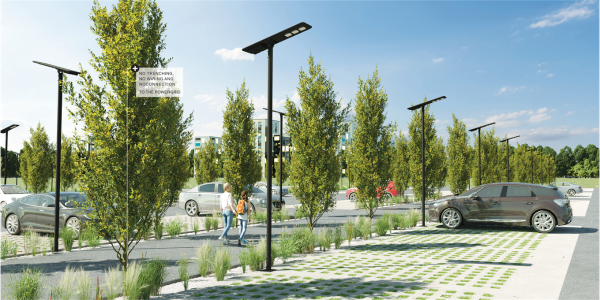
- Plazas and open pedestrian areas — symmetrical distribution works well here. The space is open, the occupancy is dispersed, and even, ambient illumination supports both safety and atmosphere. Fixture spacing can be calculated to achieve consistent overlap across the entire area.
- Facade and architectural lighting — asymmetrical, almost without exception. Grazing a wall surface, washing a building elevation, or accenting a landscape feature all require directed output. Symmetrical fixtures used for this purpose typically produce hot spots directly below the source and fall off rapidly toward the edges of the surface.
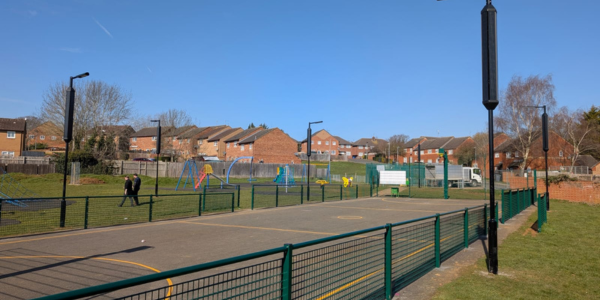
- Parks and landscape zones — often a combination. General ambient lighting across open lawn areas may use symmetrical bollards or pole-mounted fixtures, while path lighting, tree uplighting, and architectural accent work within the same space will call for asymmetrical distribution.
Interior applications: the same logic, smaller scale
The same principles apply indoors. A pendant over a dining table benefits from symmetrical distribution — the goal is even light across the surface below. A wall washer in a gallery or a cove fixture over a kitchen counter needs asymmetrical distribution to deliver light to the surface rather than back toward the ceiling or into the room.
Recessed downlights with asymmetrical optics are used to illuminate vertical surfaces — shelving, artwork, feature walls — without the light bouncing back and creating glare in the space. The fixture appears to face straight down; the light lands on the wall.
The specification question
Before selecting a fixture for any application, two questions are worth asking clearly:
- Where exactly does the light need to land?
- What happens to the light that misses that target?
If the answer to the second question is "it doesn't matter much" — symmetrical distribution is likely fine. If wasted output means glare, light trespass, energy loss, or an underlit surface somewhere else — asymmetrical distribution is the right starting point.
Other News Content by:
Bullard Outdoor
Pole Luminaires: The Complete Specification Guide for Park, Urban, and Pathway Lighting
Featured Products | September 24, 2026 | The Lighting ExchangeUnderstanding Dark Sky Lighting — And Why It Matters
Featured Products | August 18, 2026 | The Lighting Exchange