

Silk — The Six Years Behind the Light
Design Tips & Techniques | July 10, 2026 | The Lighting Exchange
When a material has a 5,000-year history, it deserves more than a footnote on a spec sheet.
Silk isn't a finish or a coating — it's the result of an entire living system, one that took us six years to fully control from beginning to end. This is the story of what that actually means.
It starts with a worm
The silkworm — Bombyx mori — is one of the most remarkable creatures in the natural world, and one of the very few that humans have domesticated so completely that it can no longer survive without us.
It doesn't look like much. A small white larva, hatched from an egg no bigger than a pinhead, that will spend its entire short life eating, growing, and ultimately producing one of the finest natural fibers on earth. Each silkworm spins a single continuous filament to form its cocoon — a thread that, if unwound completely, can stretch up to 900 meters. From that filament, silk is made.
But here's what most people don't know: the silkworm only eats mulberry leaves. Not any mulberry — the right mulberry, grown correctly, harvested at the right time. If the leaves aren't good, the worms simply won't eat them. They refuse. There's no workaround. The quality of the silk begins in the soil.
The mulberry question
Mulberry cultivation — moriculture — is the foundation of everything that follows. The trees must be grown and maintained specifically for their leaves, harvested at the right point in the season, and fed to the silkworms fresh. The worms are extraordinarily sensitive. Temperature, humidity, the quality of the leaf, the timing of each feeding — all of it affects the quality of the cocoon and, ultimately, the quality of the silk filament.
One kilogram of mulberry leaves feeds approximately 50 silkworms through their entire lifecycle, from egg to cocoon. That number gives some sense of the scale involved in producing silk at any meaningful quantity — and why controlling the full supply chain, rather than buying raw silk from an intermediary, is the only way to guarantee consistency.
Six years to get it right
Vertical integration in silk production sounds straightforward in principle. In practice, it took us six years.
Growing the mulberry trees to a productive standard. Learning the rearing conditions the silkworms require. Harvesting the cocoons at the right moment. The washing — removing the sericin, the natural gum that holds the cocoon together, without damaging the filament beneath. The reeling, where individual filaments from multiple cocoons are drawn together into a single usable thread. And then the final step: integrating that thread into a lighting fixture in a way that preserves its optical properties, meets electrical safety standards, and holds up over years of use.
Every step in that chain had to be understood, controlled, and refined before the material could be trusted at the quality level a lighting product requires. Six years isn't an exaggeration. It's what it took.
Not what you expect to touch
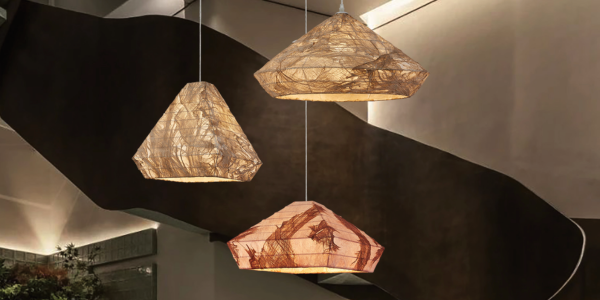
There's something that surprises people when they first handle our silk shades. Silk has a reputation for softness — and it earns that reputation as a fabric against skin. But as a structural material for lighting, it tells a different story. Mulberry silk in this form is firm, almost rigid to the touch. The tightly wound filaments, layered and treated through the production process, create a material with real body and resistance. It holds its shape. It doesn't drape or yield the way people expect.
That firmness is not a flaw — it's exactly what makes it suitable for a luminaire. A shade needs to maintain its geometry under heat, over time, and across changing conditions. The structural integrity of mulberry silk, which surprises on first contact, is what allows the material to perform as well as it looks.
What silk does to light
Silk's natural fiber structure transmits light differently from any synthetic material. It doesn't simply diffuse — it filters and softens, giving the light a warmth and dimensionality that acrylic or polyester fabric can't replicate. When lit from within, the surface becomes luminous, with a depth that makes the light seem to come from the material itself rather than through it. Unlit, a silk shade has texture, sheen, and presence. Lit, it transforms.
Why it matters for a project
For architects and interior designers, specifying silk means specifying a material with a traceable, controlled origin — not a generic textile description. It means understanding that the warmth and quality of light the fixture produces is a direct consequence of how the silk was grown, harvested, and processed.
FAQ
Why mulberry silk specifically? Mulberry silk — produced by the Bombyx mori silkworm — is the finest and most consistent silk commercially available. The controlled diet of mulberry leaves produces a filament that is uniform in diameter, exceptionally strong, and naturally lustrous. Other silk types vary more in quality and texture, making them less suited to precision applications like lighting.
Why does the silk feel hard rather than soft? The softness associated with silk comes from how it's woven and finished for fabric applications. In our shades, the silk is processed and structured specifically for use as a luminaire material — layered, treated, and formed to hold its shape. The result is firm and rigid, which is exactly what a shade needs to maintain its form and perform consistently over time.
Is it durable? Yes — with the right care. Mulberry silk is naturally strong, UV-stable when used with LED sources, and resistant to deformation. We specify LED light sources in all our silk fixtures to manage heat, which is the primary factor in long-term material performance.
Can it be cleaned? Silk shades should be dusted with a soft, dry cloth. Silk is naturally resistant to static, which means it attracts less dust than many synthetic alternatives. Direct contact with liquids should be avoided.
What makes your silk different from silk used in other lighting products? Vertical integration. Most manufacturers source silk as a finished textile from a supplier. We control the process from mulberry cultivation through to the finished shade — which means we know exactly what the material is, how it was produced, and what its performance characteristics are.
Is it available in different colors? Our silk shades are available in their natural color range — the warm, slightly varied tones that come directly from the material itself. Because the color is inherent to the fiber rather than applied as a dye or coating, it has a depth and naturalness that uniform synthetic colors don't replicate.
Other News Content by:
Lola Lighting
Alabaster vs. Concrete vs. Ceramic: Comparing Lola's Stone & Mineral Materials
Featured Products | September 24, 2026 | The Lighting ExchangeAlabaster Lighting: When Stone Learns to Glow
Design Tips & Techniques | August 18, 2026 | The Lighting Exchange